
The Cape Cod School for Drawing and Painting
Kelly Knight, MFA, and Elspeth Slayter, MSW, MA, PhD
Sail Loft Art Collective, Provincetown, MA
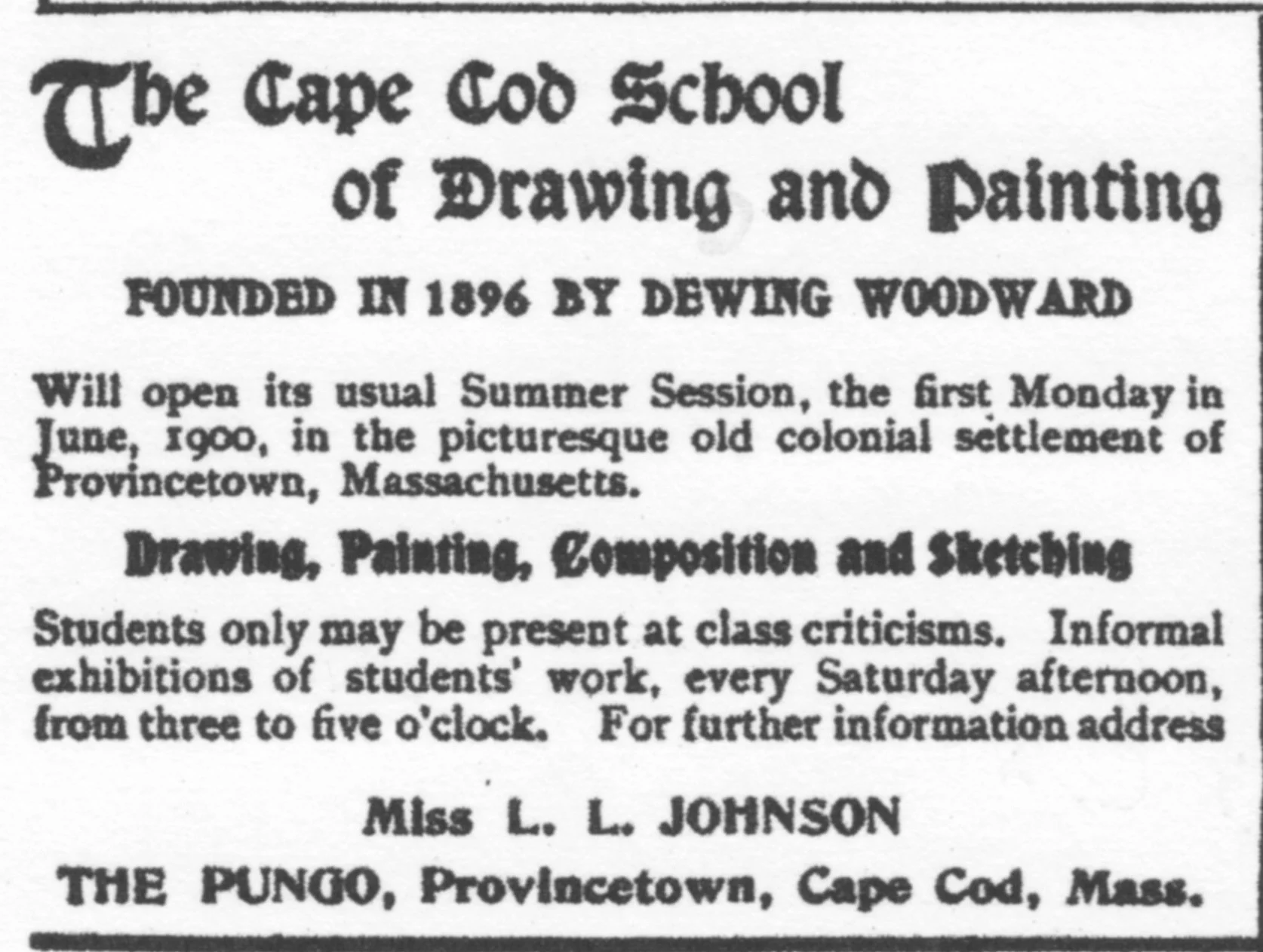
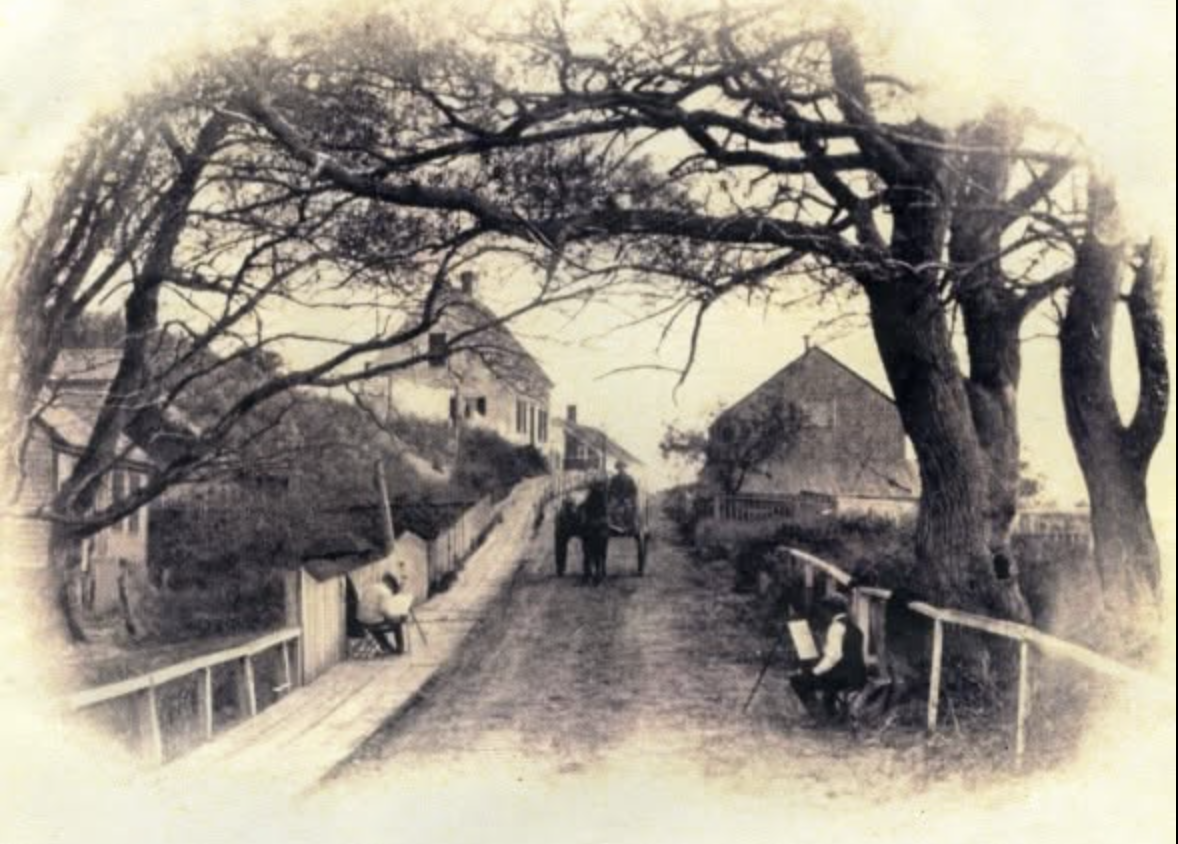
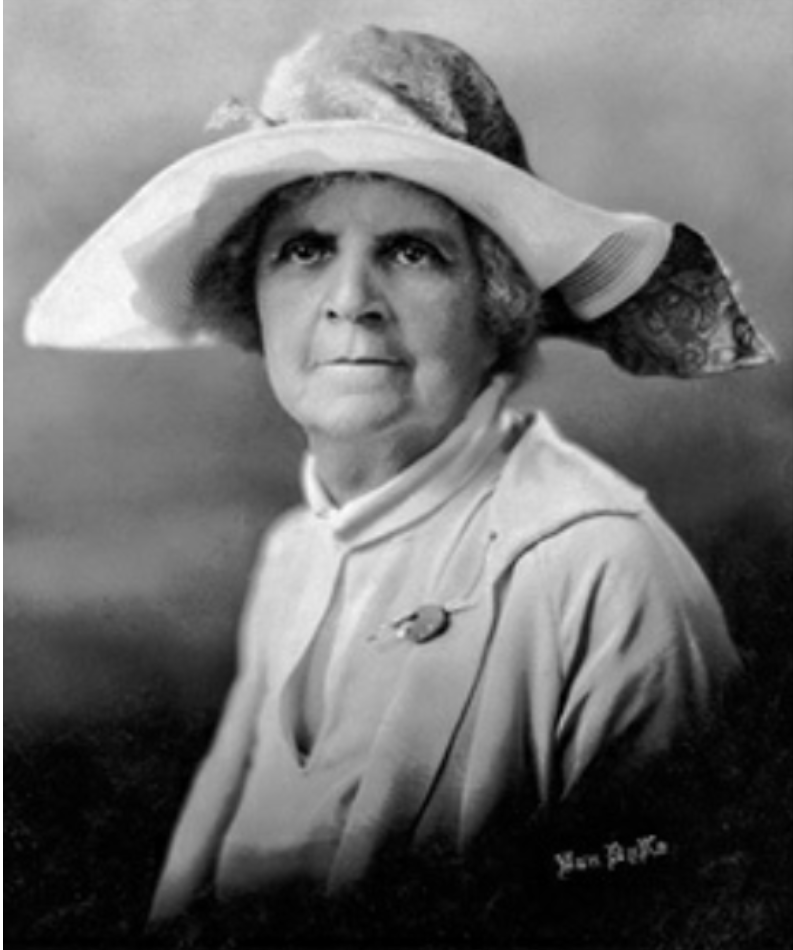
Provincetown, Cape Cod, Massachusetts, has long been known as a haven for artists; in fact, it is considered America’s oldest continuous art settlement, often called a "colony." Charles Hawthorne is often credited with founding the Cape Cod School of Art in 1899 and establishing Provincetown as an art colony. However, three years prior to the founding of Hawthorne’s school, in 1896, Martha Dewing Woodward (pictured above to the right, who preferred to be called “Dewing-Woodward”) and her life partner, Laura Louise Johnson (Weber, 2024; Sieminski, 2013), founded the first formal art school in Provincetown: Cape Cod School of Drawing and Painting (Dunlop, 2015, see image on upper left from 1900, advertising the School in The Art Interchange). The School was located at 18 Commercial Street, owned by Dewing-Woodward and Johnson, and students stayed nearby in other rented homes (see center image above from Lisa King’s My Grandfather’s Provincetown). The School's curriculum focused on teaching outdoor "plein-air" painting with nude models.
English professor Dr. Ralph Rees was the first to document this part of Provincetown's art history, using Woodward’s letters and other archival materials to write "The Search for Dewing-Woodward: Revealing a Life and the Difficulty of Documenting That Life" in the journal Bucknell World (Rees, 1991). Dr. Rees was particularly interested in Dewing-Woodward as she had taught art at the school that later became Bucknell University. Starting in 2013 (Sieminski, 2013), librarian Mary Sieminski and art history professor and curator Dr. Melissa Renn of Harvard University’s School of Business further researched the School’s history. After presenting their research at the Provincetown Public Library (Sieminski & Renn, 2018a), they published an article on the topic in Provincetown Arts (Sieminski & Renn, 2018b). More recently, two journalists at The Provincetown Independent also mentioned the school in their research on the town’s art history (Abel, 2024; DaSilva, 2025).
History may have remembered Dewing-Woodward and Johnson’s role in establishing Provincetown as a significant arts colony if not for their gender, and if not for the tragic destruction of the School itself. The building at 18 Commercial Street, named “Pungo”, was lost to fire on December 6, 1907, along with a large portion of Dewing-Woodward's artwork, life's output, and student works housed in the studio. The fire also destroyed written course materials, art theory lectures, and teaching documents compiled for the school. ("Antiques Burned," 1907). The Boston Journal reported that because the School sat at the far end of Commercial Street, firefighters could not contain the blaze, and it burned to the ground ("Antiques Burned," 1907).
A letter from Dewing-Woodward shows that, before losing the building and its contents, the couple planned to live out the rest of their lives in Provincetown. “In a letter to friends at Bucknell, she said, I collapsed—did not touch a brush for four years. I had just been to France to close our studios and bring everything home to spend the rest of my life here, and the cases were not yet unpacked” (Letter to Friends, 1942). She went on to say she couldn't paint for some time: “I took to writing and published a lot of short stories, one book, and several articles, but I returned to my easel and have painted ever since.” (Siemenski 2013)
The total destruction of their work and property ultimately led Dewing-Woodward and Johnson to close the School and leave Provincetown, moving their work to Woodstock, New York, where they founded the Blue Dome Fellowship, another art school (Johnson, 1917).
Dewing-Woodward’s Career
At the time of her death in 1950, The New York Times noted that Dewing-Woodward was one of the nation’s leading painters who had exhibited her work in the Louvre Museum in Paris, France, and in the Corcoran Gallery in Washington, DC ("Dewing-Woodward, Artist, 94, Dies," 1950). Over the decades, she was awarded multiple prizes for her work, particularly in France, where she painted under both her birth name and her preferred name, “Dewing-Woodward” (Hellenica World, 2026). In 1894, she won the Grand Prix Concours de Portrait and won medals in Marseilles and Nantes. Sieminski (2013) notes that Woodward’s paintings were held by “the Baltimore Museum of Art, the University of Miami, the Deschanel Collection in Paris, and many other institutions. First Lady Eleanor Roosevelt also noticed Woodward, choosing two of her paintings, “Flamingos” and “Great Blue Herons,” for display in the Treasury Building in Washington, D.C. President Franklin Delano Roosevelt also bought her painting “The Harvard Quilt” for the family’s Hyde Park residence (Hellenica World, 2026).
Woodward began her art studies at the Pennsylvania Academy of the Fine Arts in Philadelphia under the realist painter Thomas Eakins (Sieminski, 2013). She went on to teach for much of her career, including at the Hattie Hall Seminary for Young Ladies in Williamsport, Pennsylvania (c. 1870s–1882), and at the Woman's College of Baltimore—now Goucher College—in Maryland (1882–1892), where she was the head of the art department. She served as principal of Goucher’s School of Art from 1891-1892 (Sieminski, 2013), and taught at the Ethical Culture School in New York City in the mid-1890s (Marquis, 1909; Sieminski, 2013). Later in her career, she taught at the University of Miami Conservatory of Music in Coral Gables, Florida (1926–1928)
To further expand her skills mid-career, Woodward and Johnson traveled to Paris, where she enrolled at the Académie Julian and the Académie Colaross, at the epicenter of the late 19th-century art world. In these Parisian studios, she trained under William-Adolphe Bouguereau, Tony Robert-Fleury, and Jules Joseph Lefebvre, absorbing rigorous academic techniques in figure drawing and composition that would later inform her career as a painter and art educator (Benezit Dictionary of Artists, 2011).
But in spite of her credentials and skills as a painter, Woodward, like most women artists of the time, was denied professional opportunities because of gender discrimination. In France, she was forced to withdraw the painting “Wooden Shoemakers” from the Paris Salon. This happened when her teacher and mentor, Jules Le Febre of the Academie Julian, told the exhibition jury that the painter was a woman and “who knows who might have helped her!” (Rees, 1991). This experience prompted Woodward to drop ‘Martha’ from her name, and she began using her more androgynous middle name, Dewing, with no Mrs., Ms., or Miss, given that she eschewed the need for gender or marital status designations (Siemenski 2013, Rees 1991; Letter to Bucknell Friends, 1942)
After losing the school she founded in Provincetown, Woodward and Johnson relocated to Woodstock, New York, where they founded the Blue Dome Fellowship. There, Woodward served as president and instructor (1907–1918). Woodward also taught at the University of Miami Conservatory of Music in Coral Gables, Florida (1926–1928) (Sieminski, 2013).
Laura Louise Johnson, Woodward’s companion who lived with her while she studied art in France and ran the School in Provincetown, was also an artist, although little is known about her life or work (Sieminski, 2022). She studied with Dewing and served as her secretary, model, and companion. She displayed her work in Williamsport, New York, Provincetown, Woodstock, and Coral Gables (Sieminski, 2022).
Of her life in Florida, Sieminski (2022) notes that researcher Dr. Julio Capo describes Woodward as an artist and civic leader who “helped shape the fairyland image, all while challenging established gender and sexual mores.” Further, Sieminski (2022) notes that in chronicling Miami’s queer past from its 1896 founding through 1940, Capo shows the different ways gender and sexual renegades made the city their own, placing Dewing in the context of LGBTQ Miami.
References
Abel, K. (2024, December 25). In search of Helltown. The Provincetown Independent. https://provincetownindependent.org/history/2024/12/25/in-search-of-helltown/
Antiques burned with artists' bungalow. (1907, December 7). Boston Journal, 3.
Benezit dictionary of artists. (2011). Oxford University Press. https://doi.org/10.1093/benz/9780199773787.article.B00050831
DaSilva, A. (2025, October 22). Spencer Keasey selects five historic women artists. The Provincetown Independent. https://provincetownindependent.org/arts-minds/2025/10/22/spencer-keasey-selects-five-historic-women-artists/
Dewing Woodward, artist, 94, dies. (1950, July 14). The New York Times, 18.
Dunlap, D. W. (2015). Building Provincetown: A guide to its social and cultural history, told through its architecture. Town of Provincetown.
Hellenica World. (n.d.). Martha Dewing Woodward. Retrieved October 13, 2026, from https://www.hellenicaworld.com/Art/Paintings/en/MarthaDewingWoodward.html
Johnson, L. (1917). Blue Dome Fellowship: An association of artists and students affiliated for mutual benefits in the study of light and color under the open sky [Pamphlet]. Blue Dome Fellowship.
Lawless, D. (2011). Provincetown: A history of artists and renegades in a fishing village. Arcadia Publishing.
Letter to Bucknell Friends, Sept. 21, 1942, Coral Gables, in Bucknell Archives.
Marquis, A. N. (Ed.). (1909). Woodward, Dewing. In Who's who in New England (1st ed., p. 1039). A. N. Marquis & Company.
Rees, R. (1991). The search for Dewing Woodward: Revealing a life and the difficulty of documenting that life. Bucknell World, 19(1), 14–15.
Sieminski, M. (2022). One of the Nation’s Leading Painters, Forgotten and Then Rediscovered. Unpublished research notes.
Sieminski, M., & Renn, M. (2018a, September 11). Dewing Woodward, Louise Johnson, and the founding of the first art school in Provincetown [Lecture]. Provincetown Public Library, Provincetown, MA, United States.
Sieminski, M., & Renn, M. (2018b). Pioneer of Provincetown: Dewing Woodward and the Cape Cod School of Drawing and Painting. Provincetown Arts, 33, 22–23. https://archive.org/stream/PtownArts2018/PtownArts-2018_djvu.txt
Sieminski, M. L. (2013, June 9). Dewing Woodward: Williamsport's bold vagabond artist. Williamsport Sun-Gazette, E1, E3. https://www.sungazette.com/life/lifestyle-news/2013/06/dewing-woodward-williamsport-s-bold-vagabond-artist/
Weber, B. (2024, May 3). Dewing Woodward and the Blue Dome Fellowship. Learning Woodstock Art Colony. https://www.learningwoodstockartcolony.com/post/dewing-woodward-and-the-blue-dome-fellowship